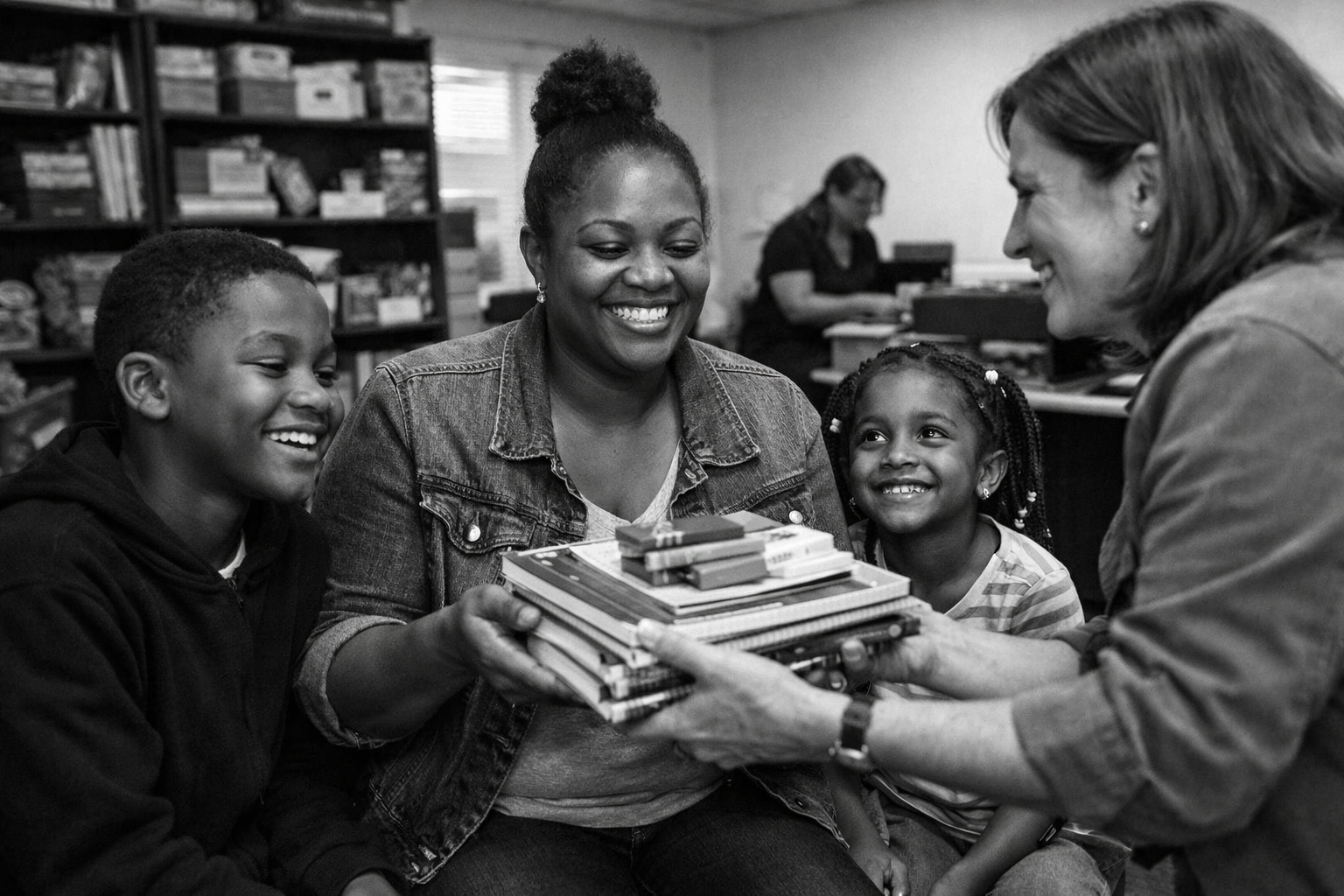
The Problem We Are Solving
Educational inequality in the United States remains one of the most persistent and consequential social crises of our time. According to the National Center for Education Statistics (NCES), approximately 11.6 million children in the U.S. live in poverty — and children from low-income households are 13 times more likely to drop out of school than their higher-income peers.
In DeKalb County, Georgia — where NAAFSRI is based — the data is particularly stark:
- 18.4% of children live below the federal poverty line (U.S. Census Bureau, 2023)
- 1 in 4 students lacks access to basic school supplies at the start of each academic year
- Only 62% of low-income students in the county graduate on time, compared to 89% of their higher-income peers
- Access to after-school tutoring is limited to families who can afford private services, creating a compounding disadvantage
Research from the Brookings Institution confirms that early educational investment yields a return of $7–$12 for every $1 spent, through reduced crime, improved public health, and increased workforce productivity. The urgency is clear: without intervention, educational gaps become generational poverty traps.
Our Core Mission
In short: we exist because a child's ZIP code should never determine their destiny. Our mission is not charity in the traditional sense — it is an investment in human capital, community resilience, and long-term social equity.
Our Long-Term Vision (5–10 Years)
By 2034, NAAFSRI envisions a North America where no child is denied educational opportunity due to economic hardship. Specifically, we aim to:
- Expand operations to serve children in 10 U.S. states, with regional hubs in the Southeast, Midwest, and Mid-Atlantic
- Award over $2 million annually in scholarships, supporting 500+ students per year
- Establish a digital learning platform providing free tutoring and educational resources to 10,000+ children nationwide
- Build a network of 50+ community partners including schools, businesses, and faith organizations
- Contribute measurably to reducing the high school dropout rate in our service communities by at least 15 percentage points
Our vision is not merely organizational growth — it is a transformed social landscape where educational equity is the norm, not the exception.
SMART Goals: Years 1–3
Award 150 need-based scholarships totaling $450,000 by December 2026, with a minimum 85% academic retention rate among recipients.
Conduct 4 annual supply drives distributing 2,000+ kits per year to families in DeKalb, Fulton, and Gwinnett counties by end of Year 2.
Establish 5 after-school tutoring centers serving 300 students weekly, achieving measurable grade improvement in 75% of enrolled students by Year 3.
Recruit, train, and retain a volunteer base of 200 active volunteers by Year 2, with a 70% year-over-year retention rate.
Diversify revenue to include at least 5 funding streams, achieving an annual operating budget of $800,000 by Year 3.
Formalize 20 corporate and institutional partnerships by end of Year 2 to support in-kind donations, volunteer hours, and co-funding.
Who We Serve
Primary Beneficiaries: Children ages 5–18 from households at or below 200% of the federal poverty line, residing in DeKalb, Fulton, Gwinnett, and Rockdale counties in Georgia. Selection criteria include household income verification, school enrollment status, and demonstrated financial need.
Secondary Beneficiaries:
- Parents and guardians — through family literacy workshops and parental engagement programs that equip them to support their children's education at home
- Local schools and teachers — through supply donations and volunteer tutoring that reduce classroom resource gaps
- The broader community — through the long-term economic and social benefits of a more educated, empowered generation
We prioritize children from single-parent households, children in foster care, and those with documented learning disabilities who face compounding barriers to educational access.
Core Programs & Priority Order
🎓 Scholarship Fund
Need-based annual scholarships for K–12 students covering tuition, fees, uniforms, and learning materials. Applications reviewed by an independent committee each spring.
📚 School Supply Drives
Twice-yearly (August and January) drives collecting and distributing backpacks, books, stationery, and digital devices to registered families.
🧑 After-School Tutoring
Free weekday tutoring in math, reading, science, and writing at community centers. Staffed by trained volunteers and supervised by certified educators.
📺 Family Literacy Program
Monthly workshops for parents on literacy strategies, homework support, and navigating the school system. Offered in English with interpretation available.
💻 Digital Access Initiative
Laptop and tablet distribution paired with digital literacy training for middle and high school students who lack home internet or device access.
🌞 Summer Enrichment
Two-week summer literacy and STEM camps to prevent learning loss during school breaks, serving 80–100 children per session.
Theory of Change
Our Theory of Change follows a clear causal pathway from resource inputs to lasting social impact:
Donations, volunteers, corporate partnerships, grants, community spaces
Scholarships, supply drives, tutoring, literacy workshops, digital access
Improved attendance, better grades, reduced dropout risk, increased family engagement
Higher graduation rates, college enrollment, economic mobility, community resilience
The underlying assumption is that when material and financial barriers are removed, children's innate capacity for learning flourishes — and that sustained community support amplifies and sustains these gains over time.
Key Performance Indicators (KPIs)
| Program | KPI | Target |
|---|---|---|
| Scholarship Fund | Annual scholarship retention rate | ≥ 85% |
| Scholarship Fund | GPA maintenance among recipients | ≥ 2.8 GPA |
| Supply Drives | Families reached per drive | ≥ 500 |
| Supply Drives | Cost per kit distributed | ≤ $28 |
| Tutoring | Students showing grade improvement | ≥ 75% |
| Tutoring | Volunteer tutor retention rate | ≥ 70% |
| Family Literacy | Parent workshop attendance rate | ≥ 60% of enrolled families |
| Digital Access | Devices distributed annually | ≥ 150 |
| Organization | Program expense ratio | ≥ 80% of budget |
Monitoring & Evaluation Plan
NAAFSRI employs a continuous monitoring and evaluation framework to ensure accountability and program effectiveness:
- Quarterly program reviews by the Program Director, assessing KPI progress and identifying corrective actions
- Annual beneficiary surveys measuring satisfaction, academic progress, and perceived impact among scholarship recipients and tutoring students
- School report card collection from scholarship recipients each semester to verify academic standing
- Volunteer feedback forms collected after each supply drive and tutoring session
- Annual independent financial audit ensuring fiscal transparency and compliance with IRS 501(c)(3) requirements
- Biennial external program evaluation conducted by a third-party nonprofit evaluation firm to assess long-term impact
All data is stored in a secure cloud-based case management system, with anonymized aggregate reports published annually in our Impact Report available to the public.
Organizational Structure
NAAFSRI operates with a lean, mission-focused team structure:
- Principal / Executive Director (Awal Khan) — Overall strategic leadership, donor relations, and external partnerships
- Program Director (1 FTE) — Oversees all program design, implementation, and volunteer coordination
- Development & Communications Manager (1 FTE) — Manages fundraising, grant writing, and public communications
- Community Outreach Coordinator (1 FTE) — Manages beneficiary intake, family services, and community partnerships
- Finance & Operations Manager (Part-time) — Handles bookkeeping, compliance, and administrative operations
- Volunteer Tutors (50–80 active) — Deliver after-school tutoring under educator supervision
- Board of Directors (7 members) — Provides governance, fiduciary oversight, and strategic guidance
Volunteer Strategy
Recruitment: Volunteers are recruited through partnerships with local universities (Georgia State, Emory, Georgia Tech), corporate volunteer programs, faith communities, and social media campaigns. We maintain an open volunteer application portal at all times.
Training: All volunteers complete a mandatory 4-hour orientation covering child safety protocols, cultural competency, and program-specific training. Tutors receive an additional 6-hour subject-matter training module.
Retention: We retain volunteers through recognition programs (Volunteer of the Month, annual appreciation dinner), flexible scheduling, professional development opportunities, and a strong community culture. Our target retention rate is 70% year-over-year.
Resource Requirements & Optimization
Key resource requirements by program:
- Scholarship Fund: Financial capital (donor funds and grants); scholarship management software; independent review committee
- Supply Drives: Warehouse space (donated by corporate partners); transportation; inventory management system; volunteer labor
- Tutoring Centers: Community center space (secured through MOUs with local governments); educational materials; volunteer tutors; basic technology (tablets, whiteboards)
- Digital Access: Refurbished laptops (sourced through corporate donation programs); internet hotspots; technical support volunteers
We optimize resource use through bulk purchasing agreements, in-kind donation partnerships with office supply retailers, and shared-space arrangements with local schools and libraries to minimize overhead costs.
Financial Resource Mobilization
NAAFSRI employs a diversified funding strategy to ensure financial resilience:
- Individual Donations (30%): Online giving campaigns, major donor cultivation, and recurring monthly giving programs
- Foundation Grants (35%): Applications to education-focused foundations including the Gates Foundation, Annie E. Casey Foundation, and local community foundations
- Corporate Partnerships (20%): Cause-related marketing agreements, employee matching programs, and in-kind sponsorships from local businesses
- Crowdfunding (10%): Annual crowdfunding campaigns on platforms such as GoFundMe Charity and Mightycause for specific program needs
- Events (5%): Annual fundraising gala, community 5K run, and silent auction events
Long-Term Financial Sustainability
To ensure organizational sustainability beyond initial grant funding, NAAFSRI is building:
- An endowment fund targeting $500,000 by Year 5, providing a permanent income stream for the scholarship program
- A social enterprise component — a fee-based tutoring service for middle-income families, with all proceeds cross-subsidizing free services for low-income children
- Multi-year corporate sponsorship agreements (3–5 year terms) providing predictable revenue
- A planned giving program encouraging supporters to include NAAFSRI in their estate plans
- Rigorous cost-per-outcome tracking to demonstrate ROI to funders and justify continued investment
Risk Management
| Risk | Likelihood | Mitigation Strategy |
|---|---|---|
| Funding shortfall / grant non-renewal | Medium | Maintain 6-month operating reserve; diversify to 5+ funding streams; build individual donor base |
| Volunteer attrition | Medium | Robust recognition program; flexible scheduling; university partnership pipeline for continuous recruitment |
| Key staff turnover | Low–Medium | Competitive compensation; succession planning; documented procedures for all roles |
| Reputational risk / safeguarding incident | Low | Mandatory background checks; child safeguarding policy; incident reporting protocol; liability insurance |
| Economic recession reducing donations | Medium | Endowment fund; multi-year grant agreements; cost-reduction contingency plan |
| Community trust / engagement decline | Low | Community advisory board; transparent annual reporting; regular beneficiary feedback loops |